October 18, 2026
Hawthorne Home Gutter Costs Explained: The Main Factors That Shape a Project
By @roofedgejournal555
A gutter project in Hawthorne is rain gutters in North Florida rarely just about hanging metal along the edge of a roof and calling it done. In this part of Florida, the real issue is water. Summer thunderstorms can unload fast. Tropical systems can push large volumes of rain in a short window. Humidity keeps organic debris damp and sticky. All of that turns gutters into part of a bigger drainage system, not a decorative add-on.
That is why two homes with a similar footprint can end up with very different project scopes. One may need a simple replacement of worn components. Another may need a full rethink of where the water goes after it leaves the roof. If you are trying to understand gutter installation cost factors Florida homeowners deal with, it helps to look past the gutter itself and think about the entire path of runoff.
In Hawthorne, the biggest price drivers usually come back to roof drainage design, site conditions, maintenance needs, and how carefully the system needs to work around outdoor features and landscaping. Those are the things that shape labor, materials, and the amount of problem-solving involved.
The biggest cost driver is usually not the gutter, it is the drainage plan
Most homeowners first notice gutters at the roofline, but the expensive mistakes often happen at the ground. Florida guidance consistently emphasizes directing downspouts away from the house and toward areas that can absorb water, such as turf or planted beds. That principle sounds simple, but it has a direct effect on project cost.
A straightforward job is one where runoff can be carried off the roof and discharged into a lawn or landscape area without causing erosion, pooling, or mess near the foundation. A more involved job is one where the installer has to work around hard surfaces, narrow side yards, fragile planting beds, or outdoor living areas. The more thought that has to go into where water lands, the more the project tends to grow.
This is especially true when the existing setup dumps water beside the house. Pooling near the foundation is not just unpleasant. It can encourage pest issues and keep areas wet that should dry out. Fixing that problem may mean changing downspout locations, extending discharge points, or routing water toward more absorbent parts of the yard. None of that is flashy, but it matters more than the color of the gutter or the marketing language on a brochure.
I have seen homeowners focus on the top edge of the system while ignoring the splash zone below. Then the first hard rain comes through, and water carves a trench through mulch, spatters the pool deck, or settles near the slab. That is when a cheap project starts getting expensive.
Roof shape changes labor more than many people expect
If a house has long, clean roof sections, a gutter project is usually easier to lay out and install. Once the roofline adds more corners, direction changes, and transitions, the work naturally becomes more detailed. More edges often mean more cuts, more joints or formed sections, and more time spent making sure the slope carries water where it should go.
This is one reason homeowners comparing estimates sometimes feel confused. They may look at square footage and assume that tells the whole story. It does not. A compact roof with simple lines may take less labor than a smaller house with multiple offsets and drainage points that are awkward to tie together.
This is also where search terms like seamless gutters Williston FL often come up in conversations, even outside Williston. Homeowners are usually trying to compare a cleaner, more custom-fitted approach with something more pieced together. The exact product choice is only one part of the equation. The roof layout still dictates how much measuring, fabrication, fitting, and adjustment the installer has to do.
Florida rain makes downspout placement a real design choice
In a dry climate, a mediocre downspout location might be an annoyance. In Florida, it can become a recurring problem. State landscaping guidance strongly favors keeping roof runoff on site when possible and directing it into areas that can absorb it. That may include turf, planting beds, rain gardens, barrels, or cisterns, depending on the property and the homeowner’s goals.
From a cost standpoint, this means every downspout should be treated as a decision, not an afterthought. If the easiest installation point sends water onto a walkway, into a narrow strip along the foundation, or against a heavily used patio, the cheapest route on paper may create the most headaches in practice.
The homes that tend to cost more are the ones where ideal discharge points are limited. A fenced side yard, dense landscaping, pool decking, or nearby structures can make it harder to send water into pervious areas. The project may then require more planning and more components to guide the runoff where it belongs.
Pool cages and outdoor living areas add complexity fast
One of the more overlooked issues in Florida is gutter drainage for pool cages and adjacent outdoor spaces. Roof runoff and drainage need careful handling around these areas because uncontrolled overflow can erode soil and create messy edges near places people use every day.
If a downspout empties too close to a screen enclosure, deck edge, or entertainment area, the result can be muddy borders, splashing, and a generally soggy perimeter after storms. Even if the gutter itself performs well, the user experience is poor. That matters because many Florida homes are built around the lanai, patio, or pool, not just the interior.
A homeowner might ask why one bid is noticeably higher than another. Quite often, the answer is that one company is simply hanging gutters while the other is thinking about where every gallon of water ends up when a summer storm hits sideways for twenty minutes. Around a pool cage, that difference shows up quickly.
Maintenance access affects long-term value, not just first-day price
Any discussion of cost should include upkeep. UF/IFAS materials note that gutters and downspouts need maintenance because leaf litter and debris contribute to drainage problems. That makes routine cleaning part of ownership in Florida, whether a home sits under heavy tree cover or only catches seasonal debris.
A system that is hard to access, hard to clean, or prone to trapping wet organic material may cost less upfront and more over time. That does not automatically mean every homeowner should buy add-ons. It does mean the maintenance reality should be part of the decision.
This is where people start comparing DIY gutter cleaning or hire a pro. The honest answer depends on height, access, roofline complexity, and personal comfort on a ladder. A low, open run with easy ladder placement is one thing. A more awkward layout near hardscapes or slippery surfaces is another. The cost of professional service has to be weighed against safety, convenience, and the risk of missing early signs of trouble such as sagging sections, loose discharge points, or overflow patterns that suggest a drainage problem.
Homeowners searching for gutter cleaning Dunnellon FL or similar service terms are usually not just shopping for debris removal. They are trying to avoid the cascade of issues that starts when a clogged system forces water over the edge and back toward the house.
Repairs can change the math of a project
Sometimes the cheapest path is repair. Sometimes repair is just postponement. The difference matters.
If a system has a localized issue, such as a section that no longer directs water properly or a downspout discharge that creates pooling, targeted work may make sense. If the bigger problem is poor layout or chronic overflow in key areas, patching one piece may not solve the reason the system fails in heavy rain.
Homeowners looking up gutter repair Hawthorne FL are often dealing with one of two situations. The first is visible damage or poor performance in a small area. The second is a recurring drainage headache that feels like a repair issue but is actually a design issue. Telling those apart is important because repeated service calls can quietly overtake the cost of a more complete fix.
A good contractor should be able to explain whether the proposed work addresses the symptom or the root cause. That conversation often reveals why one estimate seems higher. The better proposal may include changes that prevent foundation-side pooling, improve runoff direction, or reduce the chance of erosion in beds and lawn.
Tree cover, debris load, and humidity influence both design and cost
Not every Florida property sheds debris the same way. Some lots collect leaves, twigs, and organic matter all year. Others only see occasional buildup after storms. In a humid climate, debris that stays wet can compact and slow drainage faster than many homeowners expect.
That matters during installation because maintenance burden should influence the setup. It also matters after installation because the cost of ownership includes cleaning, monitoring, and occasional repair. A house tucked under mature trees may need more attention than a similar house in a more open setting.
This is where homeowners often ask about gutter guards Mount Dora FL and comparable products in their own area. Guards can be part of the conversation, especially for homes that regularly collect debris, but they are not a universal cure. Even with guards, a gutter system still needs inspection and maintenance. The point is not to assume any add-on eliminates care. The point is to decide whether the property’s debris pattern justifies an extra layer of protection and whether that trade-off makes sense for the household.
Color choices can affect approvals, even when they do not affect performance
A gutter color may seem like a simple style decision, but it can affect timelines and options if a homeowners association or architectural review committee is involved. Florida law gives associations authority over exterior appearance standards, including color and style specifications for certain exterior products, though those standards must comply with building code and cannot be used to deny conforming installations.
That means gutter colors for Florida homes are not purely about matching trim or fascia. In some neighborhoods, appearance review can shape what is allowed or what needs approval first. That does not usually change how water flows, but it can change product availability, scheduling, and decision-making.
I always tell homeowners to separate two questions. First, what drainage setup works best for the property? Second, what finish choices need review? Mixing those up can slow a project for no good reason.
Special roof conditions can influence installation details
Some projects become more technical because of the roof itself. Homeowners often ask about gutters for metal roofs Florida properties use, especially when trying to plan a replacement or update drainage after a reroof. The exact solution depends on the roof system and site drainage needs, so it is worth discussing early rather than after water problems appear.
Even without getting deep into product-specific claims, one thing is clear. Any roof condition that changes how runoff leaves the roof edge or how components need to attach can influence labor and planning. The more coordination required, the more likely the project cost will reflect that extra care.
Common myths that distort budgeting
The phrase gutter myths Florida homeowners hear most often usually comes down to oversimplification. Gutters are either treated as optional decoration or as a magic fix that solves every wet-yard problem. Neither view is very helpful.
Here are a few ideas worth setting aside:
- Bigger rain events do not mean every house needs the same setup. Site layout matters just as much as roof runoff.
- A gutter that stops overflow at the roofline has not necessarily solved the drainage problem if the downspout dumps near the house.
- Gutter guards do not eliminate maintenance. They may change the type and frequency of upkeep, but inspection is still part of ownership.
- The cheapest estimate is not always the least expensive choice if it ignores runoff direction, erosion, or recurring service needs.
- Appearance decisions, including color, can matter more in HOA communities than homeowners expect.
Those points are not sales talk. They are the practical differences between a system that merely exists and one that actually manages Florida rain well.
How to compare estimates without getting lost in the details
Homeowners do not need to become drainage engineers to compare gutter proposals. They just need to ask better questions. The goal is to understand what each estimate is solving.
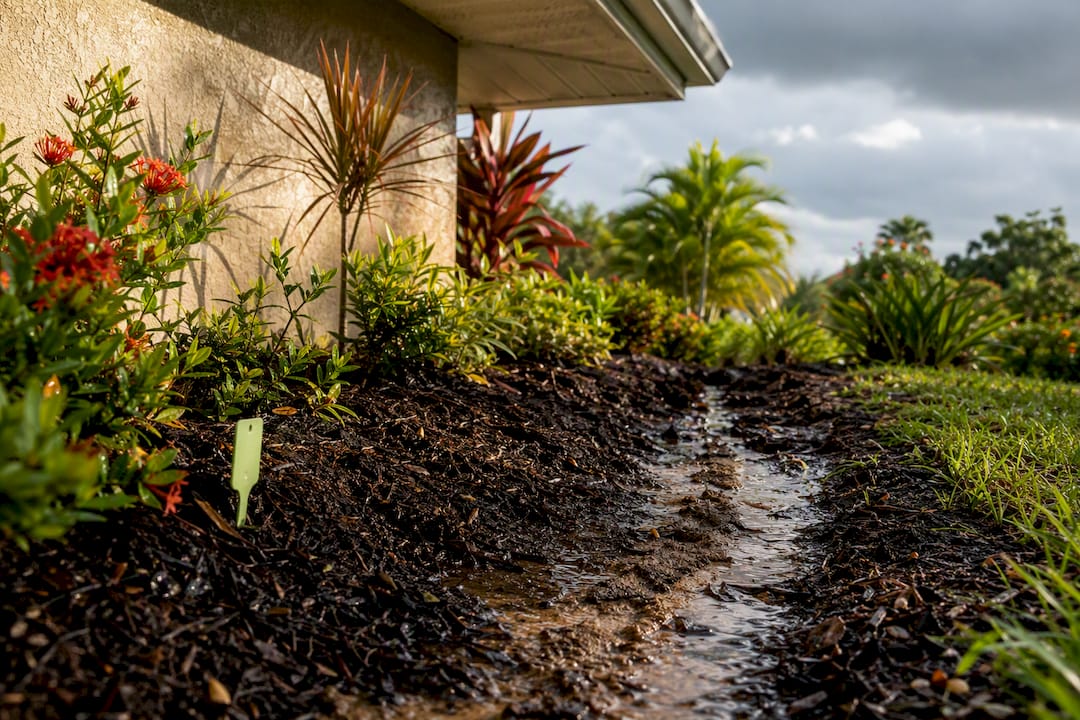
A useful comparison should cover the path of water from roof edge to discharge point. If one proposal focuses only on linear footage and another explains where the downspouts will send water, how nearby beds or turf will handle it, and whether the layout reduces pooling near the house, you are not looking at two versions of the same job. You are looking at different scopes.
A practical way to sort proposals is to look for these five points:
- Where will each downspout discharge, and will that location absorb water well?
- Does the plan move runoff away from the foundation and heavily used outdoor areas?
- How will the system be maintained, especially if the property collects leaf litter and debris?
- Are there site features such as pool cages, patios, or planting beds that make drainage more sensitive?
- Will color or style approvals affect the schedule if the property is in an HOA-governed community?
Those questions quickly expose whether an estimate is focused on appearances, function, or both.
The hidden cost of ignoring the yard
Florida-Friendly Landscaping guidance puts runoff reduction front and center for a reason. Water that leaves the roof does not disappear when it hits the ground. It enters the yard, moves across hard surfaces, soaks into planting areas, or pools where grading and drainage are poor.
This is why a gutter project should not be evaluated in isolation. If the lawn already struggles with washouts, if beds are repeatedly losing mulch, or if the side yard stays wet after storms, the gutter plan may need to address those outcomes. Sending water into pervious areas is usually the goal, but the chosen areas need to handle that volume without damage.
That is often the difference between a bare-minimum installation and a project that actually improves the property. One contains roof runoff. The other manages it.
A sensible year-round mindset saves money
The best budgets usually belong to homeowners who treat gutters as part of regular exterior care, not as a crisis purchase after overflow becomes obvious. Florida weather does not really offer a long off-season for neglect. Storms, humidity, and organic debris keep the system working year round.
A simple year-round gutter checklist Florida homeowners can follow does not need to be complicated. Look at where water lands during storms. Check whether downspouts still direct it away from the house. Watch for erosion in beds and lawn. Notice whether pool or patio edges stay messier than they should. And clean or schedule service before buildup turns into blockage.
That kind of routine attention can help catch the point where cleaning is enough, where minor repair makes sense, or where the bigger issue is the layout itself.
What usually makes a Hawthorne project cost more, or less
When homeowners ask for the short version, I put it this way. Gutter costs tend to stay lower when the roofline is simple, the downspouts can discharge easily into absorbent yard areas, maintenance access is straightforward, and there are no sensitive outdoor features in the runoff path.
Costs tend to rise when the drainage plan has to work around foundations, hardscapes, pool areas, tight side yards, landscaping that is easy to wash out, debris-heavy conditions, or appearance-review requirements. That is not unique to Hawthorne, but Florida weather makes the consequences of poor drainage show up faster.
If you keep that frame in mind, most estimate differences start to make sense. You are not only paying for gutters. You are paying for a strategy to move rainwater off the roof, away from the house, and into parts of the property that can handle it well. On a Florida home, that is the part that matters.
❧